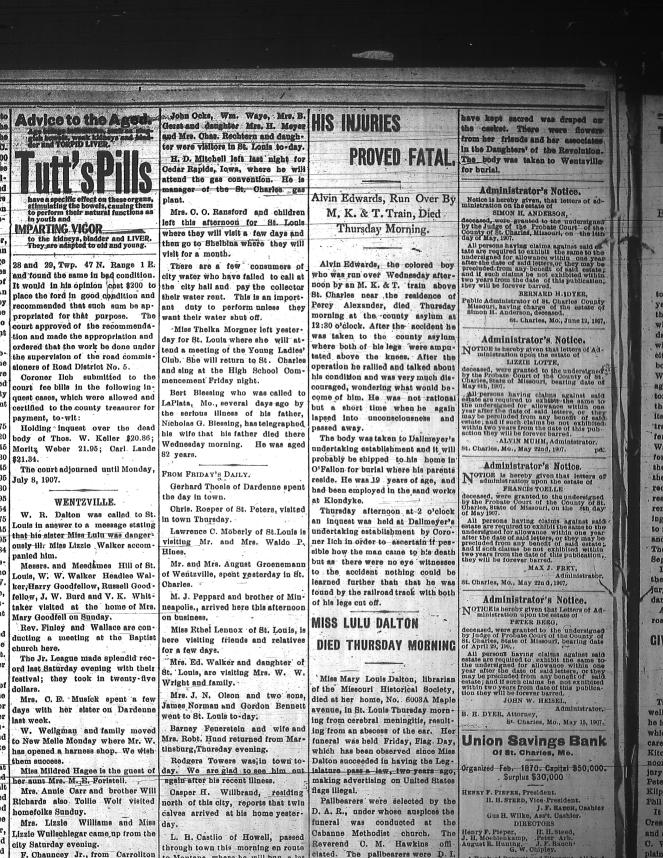
Alvin Edwards, who everyone called “Trevy”, died tragically at age 19, on June 19, 1907 when his injuries proved fatal after being run over by a train on the M.K.&T. Railroad above St. Charles. According to the June 19th, 1907 issue of the St. Charles Cosmos-Monitor (see below) there were no eye witnesses to the accident. He worked for the sand plant in Klondyke, in southern St. Charles County, and perhaps he had hitched a ride on a boxcar to get home. On the north side of St. Charles, he had jumped, perhaps he fell or slipped, and both legs were severed in the accident. Trevy had been born November of 1889, the son of James and Mary J. (nee Stone) Edwards, and grew up on “the hill” in O’Fallon. He was preceded in death by his brother Marshall and nephew Roman who are also buried at Sage Chapel Cemetery. He left behind his grieving parents and several brothers and sisters, Sedell, Mamie, Lena and Slater. He is buried in Sage Chapel Cemetery.
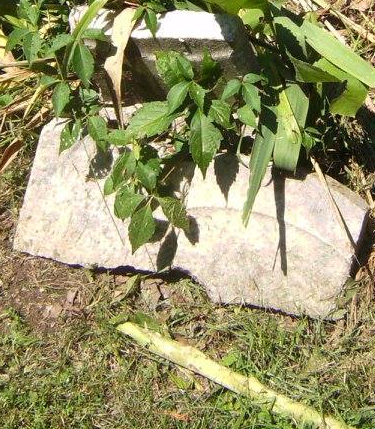
The broken pieces of Alvin Edwards stone (shown above) were recovered during a canvas and probing of the cemetery done through the efforts of a large team of local volunteers on October 29, 2017. The newspaper (below) was supplied by historian Justin Watkins.
On August 20th, in 1881, Mahala (Keithly) and her husband Jasper Costlio had transferred to the Trustees of an African Methodist Episcopal Church for the use by the Conference, one acre of land, which became known as Sage Chapel Cemetery. This was done so that the former slaves of Samuel Keithly could continue to be buried in this cemetery. That same deed conveyed a one-half acre parcel on Sonderen Street to be used for a church known as Sage’s Chapel. The members of Cravens Methodist, and Wishwell Baptist, also located on Sonderen Street, also used this cemetery to bury their families. None of these churches or their records exist anymore. Sage Chapel Cemetery is a former African American community cemetery that is maintained by the City of O’Fallon, Missouri, located at 8500 Veterans Memorial Parkway. It has 117 documented burials of which only 37 have headstones, of these we know that 17 were born enslaved. (2018) May they rest in peace “As long as a name can be spoken, that person shall not be forgotten.”
Winston Davis died in 1907. He had been born enslaved in Missouri in 1830. His parents though were property that had been brought from North Carolina. He and his wife Adelaide had ten children, of which only four were still living in 1900. Their youngest son Walter, who was born in 1871 was still living with them when Winston died. Walter had a sister named Laura, and a brother named John. Winston was buried in Sage Chapel Cemetery.
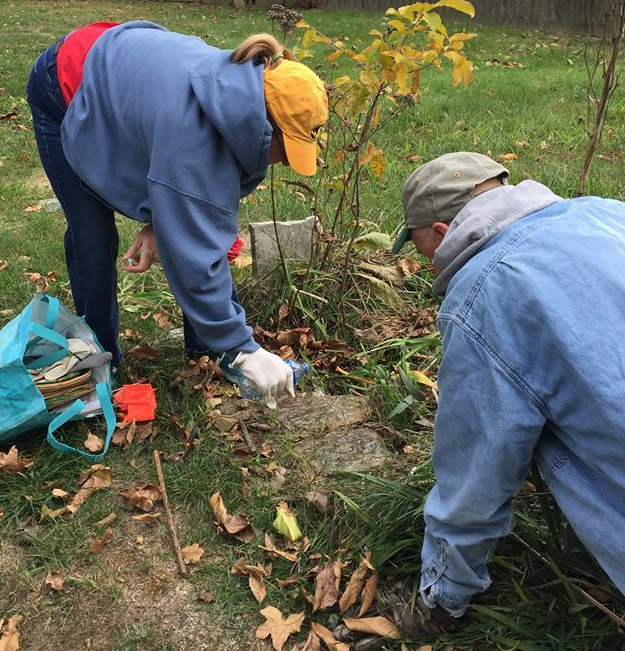
The broken pieces of Winston Davis’ stone were recovered during a canvas and probing of the cemetery done through the efforts of a large team of local volunteers on October 29, 2017. Photo by Dorris Keeven-Franke with Mary Hogan Smith and Rick Dotson. Mary came that day and shared several stones that she knew the location of. The preservation efforts of Sage Chapel Cemetery is a community wide effort.
On August 20th, in 1881, Mahala (Keithly) and her husband Jasper Costlio had transferred to the Trustees of an African Methodist Episcopal Church for the use by the Conference, one acre of land, which became known as Sage Chapel Cemetery. This was done so that the former slaves of Samuel Keithly could continue to be buried in this cemetery. That same deed conveyed a one-half acre parcel on Sonderen Street to be used for a church known as Sage’s Chapel. The members of Cravens Methodist, and Wishwell Baptist, also located on Sonderen Street, also used this cemetery to bury their families. None of these churches or their records exist anymore. Sage Chapel Cemetery is a former African American community cemetery that is maintained by the City of O’Fallon, Missouri, located at 8500 Veterans Memorial Parkway. It has 117 documented burials of which only 37 have headstones, of these we know that 17 were born enslaved. (2018) May they rest in peace “As long as a name can be spoken, that person shall not be forgotten.”
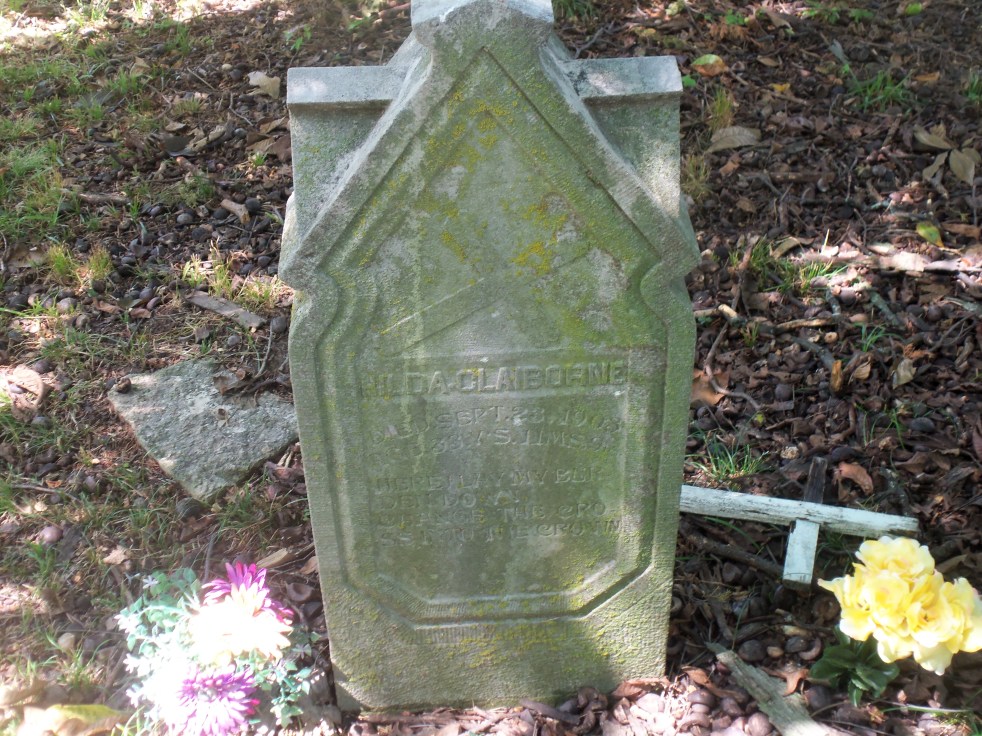
Hilda Abington Claiborne who died September 23, 1903 in Saint Charles County was born Hilda Abington on October 14, 1869. On August 1, 1889 she was united in marriage to Sandy Claiborne. She left behind her loving husband and three sons, Ollie born May 1890, Pitman born December 1892, and Sidney born February 1896. The family lived on “The hill” in O’Fallon, Missouri. Hilda Claiborne’s headstone reads Here I lay my burden down turn the cross into a crown.
On August 20th, in 1881, Mahala (Keithly) and her husband Jasper Costlio had transferred to the Trustees of an African Methodist Episcopal Church for the use by the Conference, one acre of land, which became known as Sage Chapel Cemetery. This was done so that the former slaves of Samuel Keithly could continue to be buried in this cemetery. That same deed conveyed a one-half acre parcel on Sonderen Street to be used for a church known as Sage’s Chapel. The members of Cravens Methodist, and Wishwell Baptist, also located on Sonderen Street, also used this cemetery to bury their families. None of these churches or their records exist anymore. Sage Chapel Cemetery is a former African American community cemetery that is maintained by the City of O’Fallon, Missouri, located at 8500 Veterans Memorial Parkway. It has 117 documented burials of which only 37 have headstones, of these we know that 17 were born enslaved. (2018) May they rest in peace “As long as a name can be spoken, that person shall not be forgotten.”
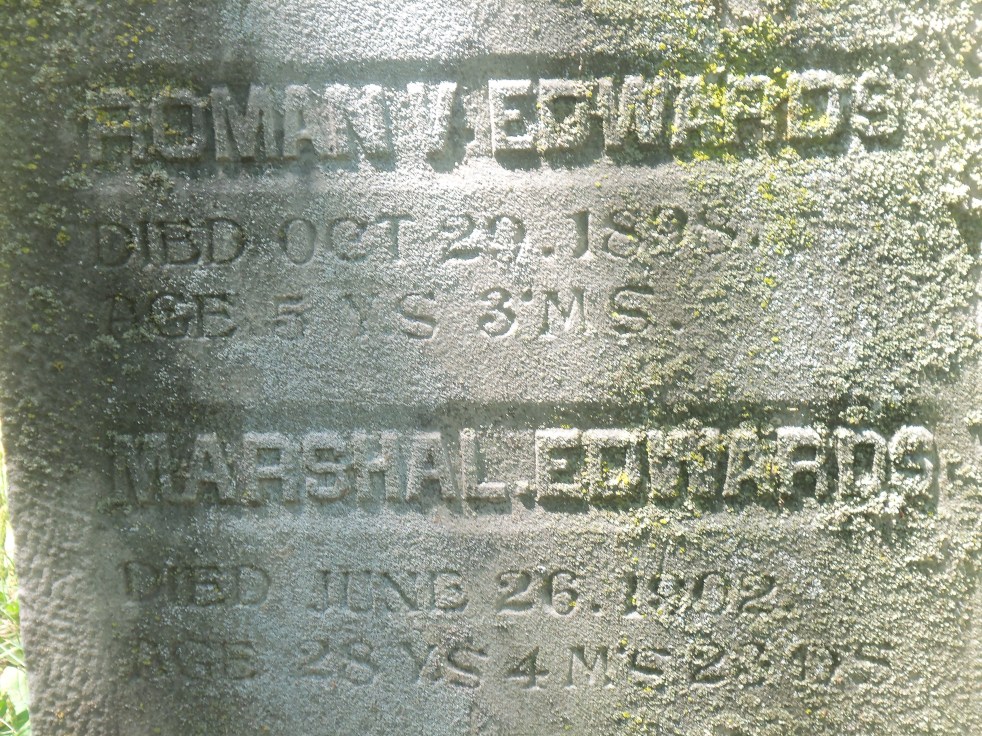
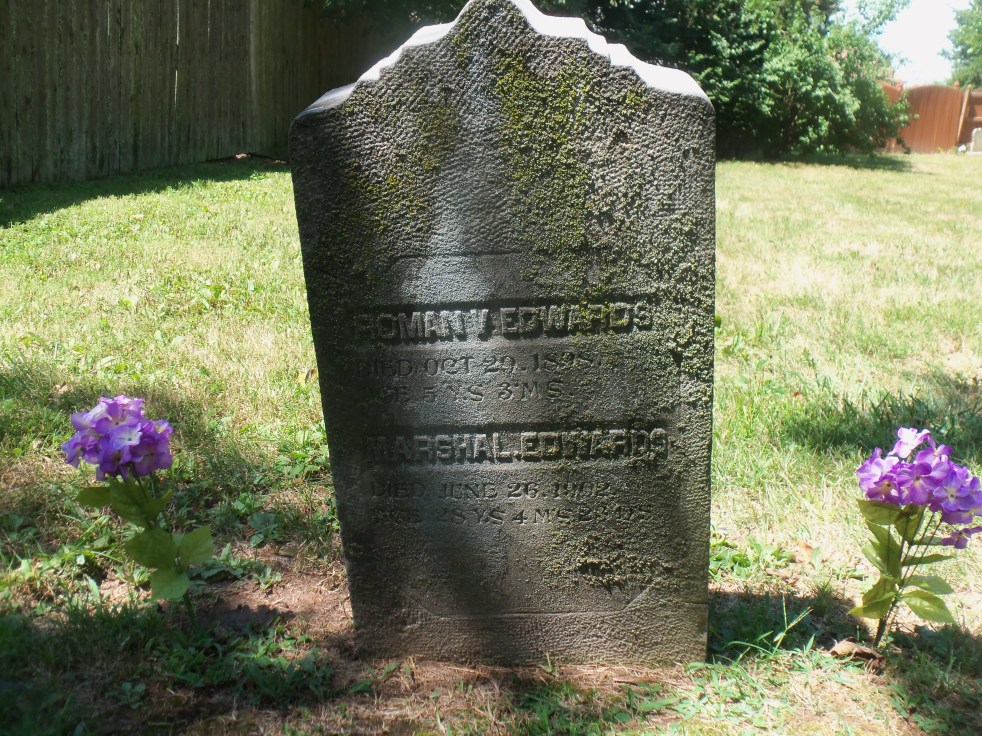
Marshall Edwards died June 26, 1902. He was born the son of James and Mary J. (Stone) Edwards on February 3, 1874 in O’Fallon, Missouri, and grew up on the hill. He was the oldest son and left behind several brothers and sisters,Diane,John, Sophia, Louis, Trevy, George, Lena,Mamie and Slater. He leaves behind his wife Mabel, formerly Mabel Tucker. His daughter Martha will be born eight months after he died. Marshall is buried with his five year old son Roman, who preceded him in death, in Sage Chapel Cemetery.
On August 20th, in 1881, Mahala (Keithly) and her husband Jasper Costlio had transferred to the Trustees of an African Methodist Episcopal Church for the use by the Conference, one acre of land, which became known as Sage Chapel Cemetery. This was done so that the former slaves of Samuel Keithly could continue to be buried in this cemetery. That same deed conveyed a one-half acre parcel on Sonderen Street to be used for a church known as Sage’s Chapel. The members of Cravens Methodist, and Wishwell Baptist, also located on Sonderen Street, also used this cemetery to bury their families. None of these churches or their records exist anymore. Sage Chapel Cemetery is a former African American community cemetery that is maintained by the City of O’Fallon, Missouri, located at 8500 Veterans Memorial Parkway. It has 117 documented burials of which only 37 have headstones, of these we know that 17 were born enslaved. (2018) May they rest in peace “As long as a name can be spoken, that person shall not be forgotten.”
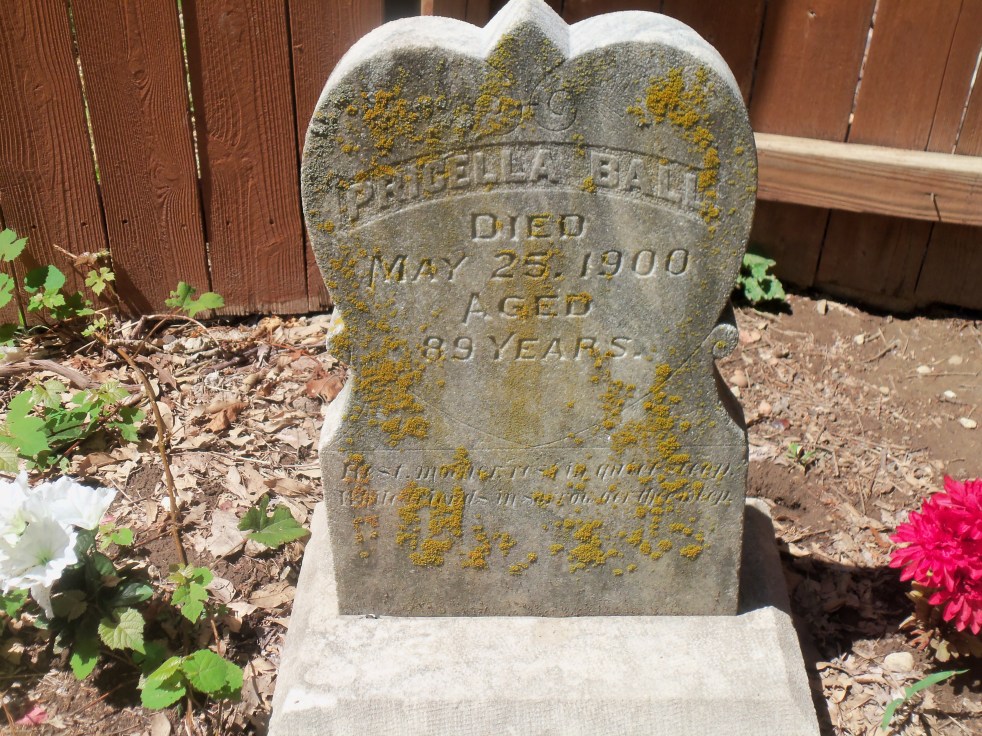
Priscella Admire Ball, formerly of Monroe, in Lincoln County Missouri died on 25th of May 1900. She was born enslaved in Kentucky in 1811. On February 6, 1866, she wed David Ball, born 1810 in Virginia. She left behind a grandson, David Clement, also born in Kentucky in 1865. This is the oldest stone found in the cemetery so far, (25 May 2023)
On August 20th, in 1881, Mahala (Keithly) and her husband Dr. Jasper N. Costlio had transferred to the Trustees of an African Methodist Episcopal Church for the use by the Conference, one acre of land, known as Sage Chapel Cemetery. Done so that the former slaves of Mahala’s father Samuel Keithly would continue to be buried with their families. It became the burying ground for many African Americans, including those from Wishwell Baptist, and Cravens Methodist (Northern) in Saint Charles County throughout the 1900s. The same deed conveyed a one-half acre parcel on Sonderen Street (known as The Hill) to be used for an African Methodist Episcopal church known as Sage’s Chapel A.M.E.. The cemetery is located at 8500 Veterans Memorial Parkway and is owned and maintained by the City of O’Fallon, Missouri. The cemetery has 117 documented burials of which only 37 have headstones, of these we know that 17 were born enslaved. The Cemetery was placed on the National Register of Historic Places on November 13, 2018. May they all rest in peace and “As long as a name can be spoken, that person shall not be forgotten.”
Roman V. Edwards, age 5 years and 3 months, died 29 October 1898. He was born May of 1893, the beloved son of Marshall Edwards, and dear grandson of James Edwards and Mary J. (Stone) Edwards. He left behind several aunts and uncles in O’Fallon, Missouri.
On August 20th, in 1881, Mahala (Keithly) and her husband Jasper Costlio had transferred to the Trustees of an African Methodist Episcopal Church for the use by the Conference, one acre of land, which became known as Sage Chapel Cemetery. This was done so that the former slaves of Samuel Keithly could continue to be buried in this cemetery. That same deed conveyed a one-half acre parcel on Sonderen Street to be used for a church known as Sage’s Chapel. The members of Cravens Methodist, and Wishwell Baptist, also located on Sonderen Street, also used this cemetery to bury their families. None of these churches or their records exist anymore. Sage Chapel Cemetery is a former African American community cemetery that is maintained by the City of O’Fallon, Missouri, located at 8500 Veterans Memorial Parkway. It has 117 documented burials of which only 37 have headstones, of these we know that 17 were born enslaved. (2018) May they rest in peace “As long as a name can be spoken, that person shall not be forgotten.”
Sage Chapel Cemetery is an African-American cemetery located on Veterans Memorial Parkway, just east of Highway K in O’Fallon, Missouri. (Just west of the VFW Post 5077) This is the only African-American cemetery still in existence in the City of O’Fallon; it most likely began as a burial ground for the former enslaved members of the Samuel Keithly household. It contains at least 117 burials that have been documented by headstones, obituaries, death certificates and/or living family members. Of these at least 17 were born into slavery. It became a formal one-acre plot when deeded to the African-Methodist Episcopal (A.M.E.) Church in 1881. The earliest visible gravestone is Priscilla Ball in 1900. African-American families have used this cemetery for well over 100 years. The church that is known to be associated with it, which was located further on Sonderen, as Sage Chapel no longer exists. African-Americans that attended Wishwell Baptist and Cravens Methodist were also buried in Sage Chapel Cemetery, and neither of these churches exist anymore either. Despite exhaustive research there are no records to any of these to be found. This continued to be used as a community cemetery for African-Americans and their families until 2015. Efforts are underway to list the Sage Chapel Cemetery on the National Register of Historic Places. That hearing will be held on August 10, 2018 at the State Historic Preservation Office in Jefferson City and is open to the public.
When researching the Sage Chapel Cemetery’s history one can be amazed at the wonderful relationship the entire community has had for years! So many people have been involved over the years, caring about this special place, and wanted to see it preserved. Sage Chapel Cemetery is a testimony to the number of people who have cared about it. Here is an excerpt from the O’Fallon Community News, 18 February 2004 by a writer named Patricia Swinger:
“Several months ago now, I got a note from Judge Earl Drennan asking me if I knew anything about the Sage Chapel Cemetery. I didn’t know anything about it, except that it was situated next to the VFW Hall on Veteran’s Memorial Parkway. To be perfectly honest, I’d never even noticed the sign “Sage Chapel Cemetery” and had never heard of the Sage Chapel. Since I’m one of those strange people who like to walk through cemeteries in historic cities, Lewis and I decided to take a look for ourselves.
What I saw on the headstones were the names of many of the black folks who lived along Sonderen Street when I was a child. Among them were Simon and Cora White, Elizabeth (everyone knew her as Grandma) Hayden, Slick Thomas and his mother. Edward Dierker who was a Blackfoot Indian … according to his granddaughter, Arlene White.
It’s been quite a task, tracking down the story behind Sage Chapel and the cemetery that took its name. I talked to Mary Stephenson whose family lived in St. Paul and then moved to O’Fallon so the children could go to Franklin High School in St. Charles. Mary went to the little white church that sat next to the creek on Sonderen, the Wish Well [sic] Baptist Church. Most of her family, though, went to the Methodist Church that was next to the black school at the corner of Sonderen and Elm. That’s the church she remembers as Sage Chapel.
I got a slightly different story, though, when I talked to Tommy White, Simon White’s son who, by the way, will turn eighty-nine this Valentine’s Day. Though the Sage Chapel he
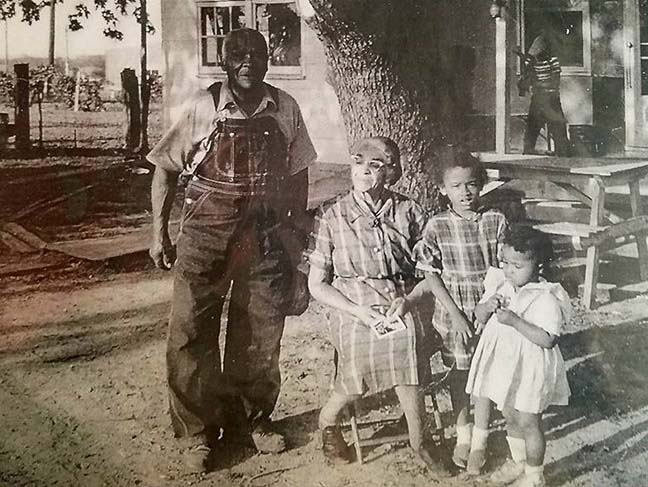
Simon and Cora White and their grandchildren
heard tell of was before even his time, it was his understanding that Sage Chapel was originally located midway on Sonderen, approximately where Pitman meets Sonderen.
All of this took place even before Sonderen Street was given its name. The Sonderen family owned a strip of farmland that stretched from Old Highway 40 all the way up to St. Joseph St., north of the railroad tracks. Frank Amptmann’s grandparents, Gerhardt and Elizabeth Sonderen, built the original Wildwood Saloon that is now Ethyl’s. According to Arlene White, the church was named Sage Chapel after the sage fields that grew wild on the middle portion of the Sonderen property. Black folks used to gather in those sage fields to worship and later on, pooled their resources to build the church. Some people understood that the land had long ago been given to the black community for a cemetery; some thought that the black families also pooled their resources to buy the land. Exactly how the land for the cemetery was transferred and where Sage Chapel was may have to remain a mystery.
It should tell us something, I think, that so few records and photographs remain to tell the story of O’Fallon’s black community. Before Sonderen Street got its name, Mary Stephenson
Sage Chapel Cemetery
tells me that this street, where most of the black folks lived, was referred to as simply “The Hill.” Arlene White told me that, in 1922, a deed for one of the properties was filed with an address that had a racial pejorative before the word “Hill.” If we’re all going to be honest enough to admit that that’s what Sonderen Street was sometimes called, let me also say that I never heard any animosity associated with the name, probably because the folks who lived there were all respected and well-liked. You couldn’t have asked for better people than Simon and Cora White who raised eight children and made sure all of them had an education. Never was there a kinder, gentler and more respected man in O’Fallon than Billie Hayden. And let’s not
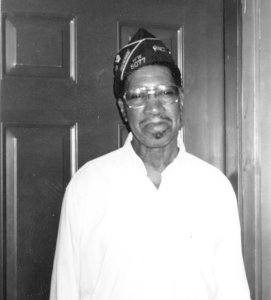
William Hayden
forget Louie Dierker, who was crippled since childhood. The story, as Arlene relayed it to me, was that he wanted to go along with the men when they rode out to the fields to work. So he jumped on the wagon and as it bounced across the field, he fell off, hit a tree and broke his back. With no medical care, the bones in his back fused as they were broken and for the rest of his life he walked with a cane, his body bent at an almost perfect ninety-degree angle. Despite that, I doubt he ever missed a day of work.
Anyone who in any way attempts to record history must at some point face the dilemma before me as I write. If this is part of O’Fallon’s history, and it is, it needs to be told and not glossed over just to make it more palatable. Yes, there was segregation, particularly where the churches and schools were concerned. Still, as Mary Stephenson said, “Most folks treated you all right—not all.”
So, to the people who now take their rest in Sage Chapel, I’d like to say a few things. To Simon White: I saw you often as I walked to school and thought to myself what a wonderful grandfather you must be. To Elizabeth Hayden: I will never forget your son’s smile and friendly wave as he drove by our house. To “Slick” Thomas: Mary Stephenson told me you were an incredible artist. I’m sorry I never knew that.”
There will be a program at the O’Fallon Historical Society with more history of Sage Chapel by Dorris Keeven-Franke, on Monday, June 4th at 6:30 p.m. and the public is invited. Please come and bring a friend.



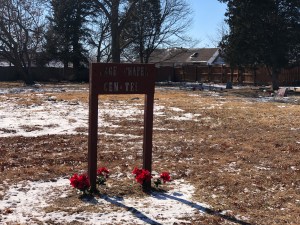 anything about the Sage Chapel Cemetery. I didn’t know anything about it, except that it was situated next to the VFW Hall on Veteran’s Memorial Parkway. To be perfectly honest, I’d never even noticed the sign “Sage Chapel Cemetery” and had never heard of the Sage Chapel. Since I’m one of those strange people who like to walk through cemeteries in historic cities, Lewis and I decided to take a look for ourselves.

 Sage Chapel Cemetery